Canada’s ties to Duvalier corruption should inform public reaction to Ottawa’s gang suppression force in Haiti.
Last week Radio Canada’s flagship investigative program Enquête revealed that provincial Liberal Party candidate Michel Leblanc was the main beneficiary of an $800,000 payment made to his lawyer father by a former finance minister during the Jean-Claude Duvalier dictatorship. In “Des fonds liés à la dictature de Duvalier aboutissent à Chambly”, the public broadcaster traced funds former minister Frantz Merceron probably stole, to a Caisse Desjardins trust account set up for Leblanc.
This is one of several examples of Canadians/institutions implicated in Duvalierist corruption. Before fleeing to the French Riviera in 1986, Jean-Claude “Baby Doc” Duvalier emptied government bank accounts. The Royal Bank of Canada (RBC) and other Canadian financial institutions assisted the young dictator’s theft. A US auditing firm hired to investigate and track down public funds concluded that Duvalier’s financial advisers “had set up an intricately concealed flow of money through a bevy of banks and accounts, most of them Canadian.”
The Royal Bank branch in Haiti assisted Duvalier. So did a Toronto branch of the bank. In Money on the Run: Canada and How the World’s Dirty Profits Are Laundered, Mario Possamai details Duvalier’s turn to Canadian institutions when Swiss banks froze Baby Doc’s accounts. At a Royal Bank branch in Toronto his attorneys converted $41.8 million ($110 million today) in Canadian treasury bills, a highly secretive and respected form of money. Once converted, the Duvaliers’ assets could no longer be scrutinized.
Despite guidelines requiring banks to determine customers’ identity, RBC admitted it simply trusted Duvalier’s lawyers. Bank officials later claimed they would have refused the transaction had they known who the beneficiaries were.
This explanation is hard to believe. The only foreign bank in Haiti for several years, the Royal Bank financed projects by the Duvalier regime. Amidst the uprising against Jean-Claude Duvalier, Royal’s senior account manager in Port au Prince, Yves Bourjolly, joined a long list of prominent businessmen who signed a statement expressing “confidence in the desire of the government for peace, dialogue and democratization … at a time when order and security appear to be threatened.”
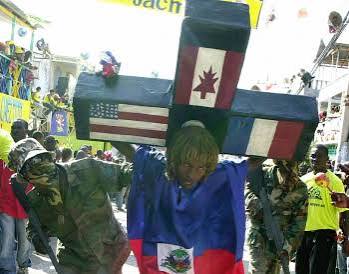
The government and Canadian elites broadly backed the repressive Jean-Claude Duvalier dictatorship. Since that time Ottawa backed efforts to maintain ‘Duvalierism without Duvalier’, participated in a questionable mid-1990s US military deployment, ousted a popularly elected government in 2004 and helped impose a former Duvalierist president in 2011.
Ottawa’s longstanding hostility to Haitian sovereignty and its impoverished masses should inform internationalists’ reaction to Ottawa’s promotion of a foreign Gang Suppression Force. At the UN ten days ago, Ottawa promoted a resolution extending its mandate until after March and Anita Anand met her unelected Haitian counterpart to discuss “support for the Gang Suppression Force.” Canada’s foreign affairs minister also announced $25 million more for security projects in Haiti while “welcoming Qatar’s recent contribution of over $14 million to the UN Trust Fund supporting the Gang Suppression Force” and “The Bahamas’ continued efforts to mobilize support for the Gang Suppression Force.”
The security situation in Port-au-Prince is dire. But it’s far from the country’s only problem. Haiti’s lack of sovereignty and the impoverishment of its masses are more entrenched problems.
But Ottawa is promoting an interventionist, repressive solution causing many deaths. According to the lead author of the Centre for Economic Policy Research Haiti blog Jake Johnston, “In the first quarter of 2026, Haitian police and private security contractors killed 1,149 people in Haiti, according to the UN. Nearly a quarter of them were civilians ‘not associated with gangs’ — about 275 people. The UN reports that armed groups killed 379 people in that same time frame. About 20% a result of intra-gang fighting. Over three months, the Haitian police killed 275 civilians. Armed groups killed about 300 civilians. That’s not the whole story of insecurity or the impact of armed groups, but still a drastically different picture than what is generally portrayed. As the US touts an even more lethal ‘Gang Suppression Force,’ stop and ask … how are gangs even stronger today after police claim to have killed nearly 5,000 in just the last 18 months?”
According to Isabelle Clerie, who leads community dialogues on transitional justice, the ‘kill all the gang members’ rhetoric dehumanizes gang members and the impoverished communities they are from. Clerie describes asking 100 women displaced by gang violence to operationalize the demand to ‘kill them all.’ Some of the questions raised were ‘With whose guns? Whose bullets? Who digs a hole big enough for the bodies of Haiti’s estimated 10,000 gang members?’”
Additionally, the women pointed out that many of the gang members — half of whom are thought to still be children — are boys the women watched grow up. Clerie notes that the discussion quickly turned to how to reintegrate gang members.
“In 20 minutes”, noted Clerie, “we dismantled kill them all”. Without that work, she said, “we’re going to just keep repeating the cycle, because we’re not actually going to dismantle the thing that is at the root of all of this.”
A factor “at the root” of Haiti’s instability is US and Canadian interference. Unfortunately, Canada hasn’t upheld the golden rule — “do unto others as you would have them do unto you” — when it comes to the nation that broke the back of racial slavery. More Canada is not the solution to Haiti’s problems.
Support Yves’ work. Donate Now.



You must be logged in to post a comment.