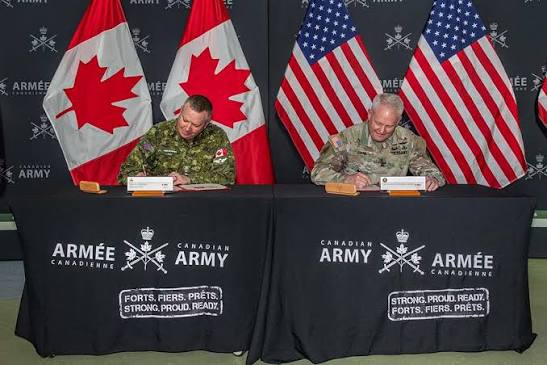
At the behest of Donald Trump Mark Carney has massively increased military spending while maintaining the armed forces’ extensive ties to their US counterparts. Still, the Trump administration is mocking Canada’s military.
On Monday, US Secretary Scott Bessent made fun of the Canadian armed forces. He stated, “We’re not at war with Canada. How are we going to be at war with Canada? What, are they going to take their two submarines from the Edmonton mall and sic them on us?” Additionally, US Secretary of War Pete Hegseth posted an image mocking Canadian Cadets.
I’m not one to defend the military or worry about petty insults, but for the military leadership and Carney administration this is embarrassing.
Upon coming to office, Trump demanded Canada massively increase an already bloated military budget. After Justin Trudeau resisted pressure to reach 2% of GDP on the military, Carney hit that target in months. He then committed to spending 5% of GDP on war and adopted a slew of measures to reach the outrageous target.
The Liberal government continued purchasing US arms and have included US branch plants as part of their “buy Canadian” weapons strategy. They haven’t even canceled the F-35 contract since the Air Force leadership wants the Lockheed Martin fighter jet.
The military hierarchy is highly differential to their US counterparts. During the past two years of Trump’s threats, they’ve sought to deepen support for the US, as Ottawa Citizen military affairs reporter David Pugliese has detailed repeatedly.
Currently, the Canadian military is co-hosting the 28th annual Indo-Pacific Chiefs of Defense Conference with the US in Victoria. Among dozens of similar exchanges, Canadian Captain Daniel Hrichishen just began the International Junior Officer Leadership Development Course in Massachusetts. Canadian Colonel Alain Lafrenière was recently Deputy Mission Commander of US Navy exercise Pacific Partnership 2026 and Canadian Colonel David K. Turenne oversaw core air operations at the massive US military base in Qatar during last summer’s US/Israeli attacks on Iran.
There are many little discussed deployments that assist US forces. In the two decades after the 2003 US invasion of Iraq a small ‘detachment’ of Canadian soldiers served under US auspices out of the Prince Sultan Air base near Riyadh Saudi Arabia. Until Iran drove them out six months ago, 200 Canadian troops were stationed at a US dominated compound in Kuwait and the Canadian forces have set up a network of international “support hubs” under the Pentagon’s direction.
From naval patrols to special forces deployments, research initiatives to wars, the $60 billion a year 100,000 strong Canadian Forces function largely as an appendage of their southern neighbour’s enormous killing machine.
On the east side of Vancouver Island, CF Maritime and Experimental Test Ranges (CFMETR) has largely been used by US nuclear-powered and nuclear weapons-capable submarines. Elsewhere the Canadian Forces’ large bases and research capacities have enabled the US war machine. In the mid-1960s US Air Force jets sprayed biological weapons simulants over Defence Research Establishment Suffield (DRES) to test spraying fatal diseases on a population. DRES was important to US researchers during the war in Vietnam. Famed investigative reporter Seymour Hersh explained, “Suffield has become colossally important to the CBW [Chemical Biological Weapons] people here in the last year. Ever since the uproar came out over tests within the United States (the summer of 69) it’s a known thing in Washington that Suffield has become the US prime testing area now.” In the 1980s DRES received a boost from the Reagan administration’s renewed interest in CBW.
Canadian special forces have deployed with their US peers across the globe. “In recent years,” noted a 2017 Washington Examiner story, Canada’s “JTF-2 has worked very closely with US forces in operations around the globe.”
As part of a late 1990s US initiative, a handful of elite JTF2 soldiers rescued NGO and church workers “threatened” by FARC guerrillas in Colombia. Alongside their US and British counterparts, 40 JTF2 members invaded Afghanistan in late 2001. On February 29, 2004, 30 JTF2 commandos ook control of the airport from which elected social democratic Haitian president Jean-Bertrand Aristide was bundled (“kidnapped” in his words) onto a plane by US Marines and deposited in the Central African Republic. Five hundred Canadian troops occupied Haiti as part of a US-instigated UN mission that installed a violent coup government.
At Washington’s urging tens of thousands of Canadians fought in Korea, Iraq, Yugoslavia, Afghanistan and Libya. Between 2014 and 2016 Canadian fighter jets joined the US bombing campaign over Iraq and Syria.
Despite extensive support for the US war machine, the Trump administration is mocking the Canadian armed forces. As a result, any self-respecting military leadership would seek to lessen its support for the US war machine.
It’s past time to sever some of the hundreds of military accords Canada has with the US. Linking to Hegseth’s post mocking Canadian Cadets, military analyst Steffan Watkins noted, “We need to retaliate in more creative ways than trade. Revoke bilateral treaties that make their life easy. Destroy them with paperwork. Demand the USAF [Air Force] e-mail GAC [Global Affairs Canada] *asking* for overflight permission 3 days in advance of all flights like other countries do; then deny a few.”
Aren’t militaries supposed to stand up for themselves?
Support Yves’ work. Donate Now.



You must be logged in to post a comment.