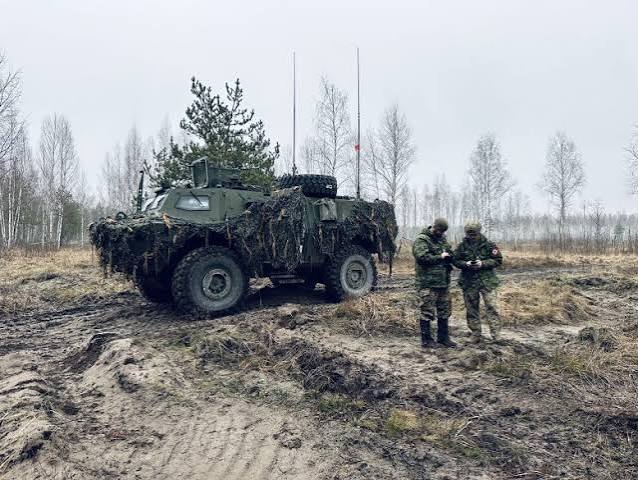
Extending and expanding Canada’s military presence on Russia’s border is apparently not newsworthy to the dominant media. Quadrupling down on a policy that’s contributed to hundreds of thousands of needless deaths, which could still lead to nuclear Armageddon is of little interest.
At the recent NATO summit Prime Minister Mark Carney “announced the extension of the Canadian-led Operation REASSURANCE until 2031, including plans to increase Canada’s persistently deployed personnel to up to 2,600.” That represents an increase from 2,200 “persistently deployed” soldiers and puts Canada’s total deployment in Latvia and elsewhere in Eastern Europe at some three thousand. With about 2,200 military personnel stationed in a country of 1.8 million, there are nearly as many Canadian troops on a per capita basis in Latvia as there are in Canada!
Carney extending Operation REASSURANCE to 2031 is an obvious bid to ‘get tough’ on Vladimir Putin. Eleven months ago, Carney traveled to Latvia to announce a three-year extension of the mission to 2029. Is the plan going forward to extend the deployment by two or three years every eleven months?
Already in 2031 Canadian troops will have been stationed on Russia’s border for 14 years. In a sign of the permanence of the deployment, Canada recently broke ground on a $70 million upgrade to its base in the country and through Operation REASSURANCE Canada has invested more than $315 million in military infrastructure in Latvia since 2017.
At the NATO summit Carney announced an expansion of Canada’s role in Latvia through NATO’s Multinational Division North and last month the head of the mission described how the Canadian-led NATO brigade of 4,000 keeps growing and bolstering its position near the Russian border. According to Defense News, “The Canada-led NATO brigade in Latvia has moved beyond its original ‘tripwire’ deterrence posture and is now focused on mounting a credible defense of the Baltic country bordering Russia, according to its commander, Col. Kris Reeves. Reeves said the shift towards what he described as ‘tactical credibility’ has meant establishing forward locations and stationing troops near Latvia’s eastern border, in the terrain where they would actually fight in the event of a conflict.”
There’s been barely a peep about the expansion and extension of the provocative deployment in the media. A July 20 “Operation REASSURANCE” Google news search for the past month unearthed a single article about Carney’s announcement in the Baltic Times. Additionally, a July 11 Journal de Montreal article headlined “Threat from Moscow: will Canadian soldiers in Latvia serve as cannon fodder?” (my translation) devoted a single sentence to Carney’s extension of Operation REASSURANCE in the ten paragraphs. (Multiple media outlets reported on two Canadian naval vessels that recently departed Halifax to join Operation REASSURANCE.)
Permanently stationing troops on Russia’s border is of little media or political interest despite its implications. According to Refdesk.ca, “The Latvia extension is a strategic bet on a long war. Extending Operation Reassurance to 2031 signals that Canada expects Russia to remain a threat throughout the decade. This is a significant policy statement: it commits CAF force generation to a specific mission for eight more years, constrains flexibility to respond to other threats (Arctic security, Indo-Pacific), and puts sustained pressure on recruitment and retention.”
Most significantly, extending Operation REASSURANCE escalates tensions with Russia. Alongside stationing troops in Latvia, Poland and elsewhere, Canada has ploughed $26 billion into the NATO proxy war in Ukraine, which is more than Ottawa spent on its 13-year occupation of Afghanistan.
Since the early 1990s Canada has steadily escalated its belligerence towards Russia. For 30 years they’ve pushed NATO expansion eastward and funded pro-Western civil society organizations. They coordinated Western diplomatic support for the 2004 Orange Revolution and when Viktor Yanukovych was elected in 2010 Ottawa worked to undermine his presidency, directly assisting the 2014 Maidan coup. Subsequently, Canada instigated Operation Unifier to assist Ukrainian forces engaged in a civil war/low-level proxy fight with Russia, which Moscow greatly expanded four and a half years ago.
Today Russia and Ukraine are increasingly attacking oil refineries and civilian infrastructure. NATO is involved in every facet of the conflict and Donald Trump appears to have largely ditched efforts to negotiate an end to the horrors. The possibility of further escalation is real.
Canada extending its mission on Russia’s border and massively increasing military spending is ratcheting up tensions at a time when humanity needs to unite to combat the climate crisis.



You must be logged in to post a comment.