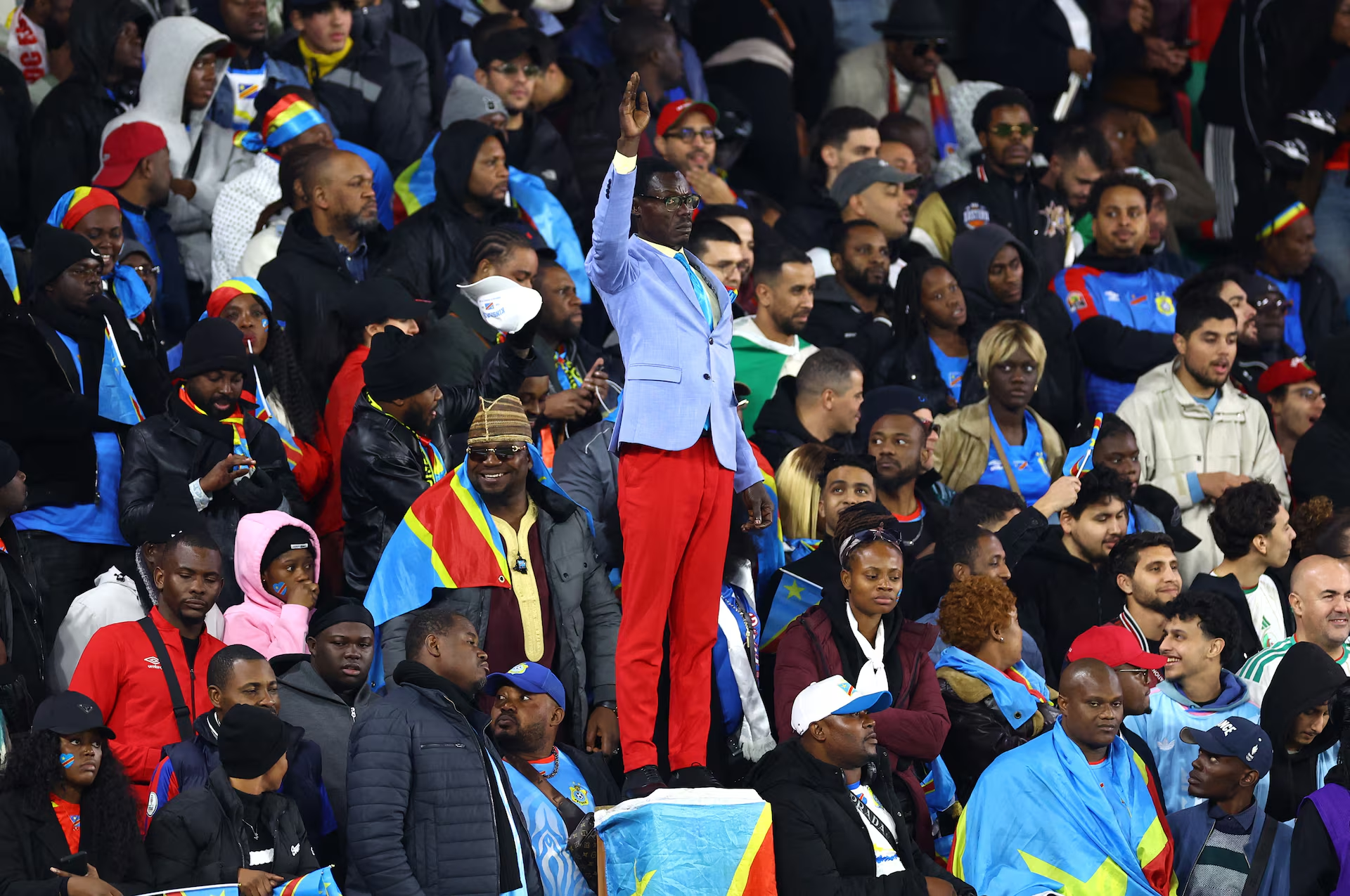
Famed Congolese football fan ‘Lumumba Vea’ is in Guadalajara for tonight’s match against Colombia. Canada contributed to his exclusion from Congo’s first game and the imperial history Lumumba Vea commemorates.
During Democratic Republic of Congo football matches Michel Kuka Mboladinga stands motionless in tribute to Patrice Lumumba who was brutally assassinated in 1961. Dressed in a jacket and tie, Mboladinga raises his arm to strike a pose similar to one held by the country’s independence leader in a prominent statue of Lumumba in Kinshasa. His stillness contrasts starkly to the fans singing and cheering around him.
Mboladinga was blocked from Congo’s first game in the US due to Ebola virus-related travel restrictions. To this country’s shame, Canada acceded (with Mexico) to the Trump administration’s push to restrict Congolese travelers in explicit contravention of World Health Organization guidance.
Canada has also contributed to the instability in eastern Congo that’s enabled the Ebola outbreak. Over the past three decades Paul Kagame’s brutal regime has unleashed incredible horrors in the region, which Canada has assisted. In 1996 Rwandan forces marched 1,500 km to topple the regime in Kinshasa and two years later they re-invaded after the Congolese government it installed expelled Rwandan troops. This led to an eight-country war between 1998 and 2003, which left millions dead. There have been multiple subsequent invasions to reassert Rwandan sway over eastern Congo, which it has pillaged of minerals.
Canada’s complicity in Rwandan violence has been varied. In 1996, Canada led a short-lived UN force into eastern Zaire (Congo) designed to dissipate French pressure for a force that would have impeded the Rwandan-led invasion. Since then, Ottawa has given Kigali financial, military and diplomatic assistance even as it has unleashed mayhem in Congo. Several Canadian mining companies have also fuelled conflict in the region.
Beyond backing Rwandan violence that has enabled the Ebola outbreak, Canadian imperialism has contributed to the impoverishment of the central African state.
Canadian troops and diplomats played an important role in the UN mission that facilitated the murder of Lumumba. Prime Minister John Diefenbaker called the popular anticolonial prime minister a “major threat to Western interests” and Canadian Colonel Jean Berthiaume assisted Lumumba’s political enemies capture him. Lumumba was handed over to soldiers under military commander Joseph Mobutu who was close to Canadian officials. Ultimately, his body was dissolved in acid.
In the 1950s Ottawa backed Belgium militarily as it sought to maintain control of its massive colony. Hundreds of Belgian pilots were trained in Canada during and after World War II and through the 1950s Belgium received tens of millions of dollars in Canadian NATO Mutual Aid. Canadian Mutual Aid weaponry was likely employed by Belgian troops in suppressing the anti-colonial struggle in Congo.
In response to a series of anti-colonial demonstrations in 1959, Canadian Trade Commissioner K. Nyenhuis reported to External Affairs that “savagery is still very near the surface in most of the natives.” In de-facto support of Belgian rule, a Canadian trade commission was opened in the colony thirteen years earlier. In the 1920s Canada’s trade commissioner in South Africa, G.R. Stevens, traveled to the Congo and reported on the Katanga region’s immense resources.
Decades earlier Royal-Military-College-of-Canada-trained officer William Grant Stairs participated in two controversial expeditions to expand European influence over eastern Congo. In 1887, Stairs was one of ten white officers in the first-ever European expedition to cross the interior of the continent, which left a trail of death, disease and destruction. A few years later the Halifax native led a 1,950-person mission to conquer the resource-rich Katanga region of the Congo on behalf of Belgium’s King Leopold II. Today Stairs is honoured with a street, island and multiple plaques, even though he was openly racist and barbarous and added 150,000 square kilometres to the Belgium’s King’s monstrous colony.
At the same time, Ontario’s William Henry Faulknor was one of the first white missionaries to establish a mission station in eastern Congo. Between 1887 and 1891 Faulknor worked under the ruler of the Yeke kingdom, Mwenda Msiri, who would later meet his death at the hands of Stairs. Faulknor’s Plymouth Brethren explicitly called for European rule (either Belgian or British) over Katanga and like almost all missionaries sought to undermine local ways.
Following Faulknor, Toronto-born Henry Grattan Guinness II established the Congo Balolo Mission in 1889. Congo Balolo Mission missions were located in remote areas of the colony, where King Leopold’s Anglo-Belgian Rubber Company obligated individuals and communities to gather rubber latex and chopped off the hands of thousands of individuals who failed to fulfill their quotas.
Faced with the violent disruption of their lives, the Lulonga, Lopori, Maringa, Juapa and Burisa were increasingly receptive to the Christian activists who became “the interpreter of the new way of life,” writes Ruth Slade in English-Speaking Missions in the Congo Independent State. Not wanting to jeopardize their standing with Leopold’s representatives, the Congo Balolo Mission repeatedly refused British-based solidarity campaigners’ appeals to publicly expose the abuses they witnessed.
Canada has played a little discussed role in the impoverishment of Congo. The imperial history Lumumba Vea commemorates at World Cup games should embarrass Canadians.
Support Yves’ work. Donate Now.



You must be logged in to post a comment.