

Canada has long assisted the US bid to suffocate Cuba. And the roots of intelligence sharing undercut the idea of Ottawa standing up to US bullying.
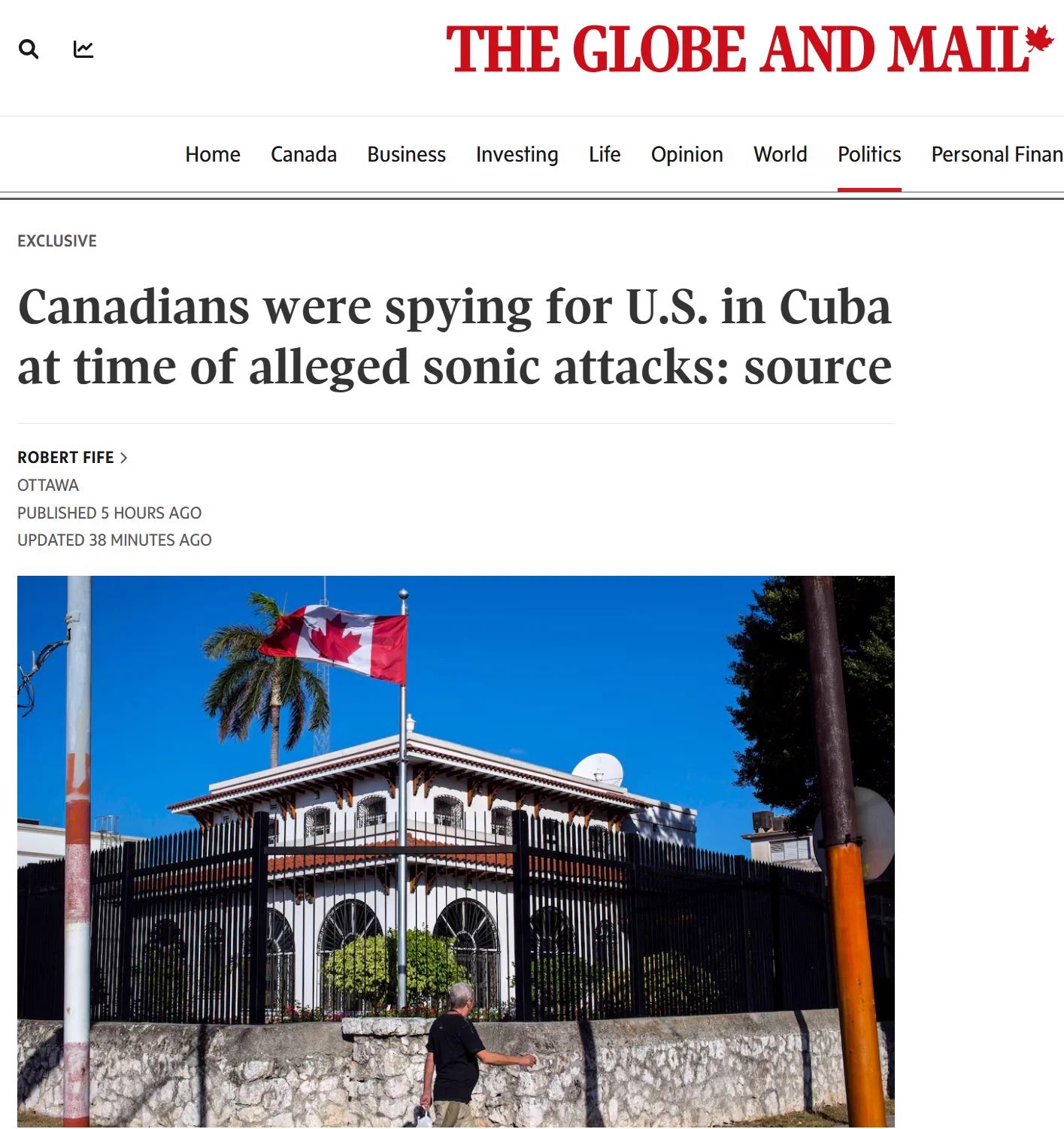
On Saturday the Globe and Mail confirmed that Canada has long spied on Cuba for the US. In “Canadians passed intelligence to U.S. at time of alleged attacks in Cuba: source”, Robert Fife reports, “A Canadian diplomat was sharing intelligence with American spies in Havana and Canadians were using satellite equipment brought into Cuba by the United States when officials from both countries began experiencing debilitating symptoms caused by alleged sonic attacks linked to Russia.”
The long story about the 2017 “Havana syndrome” describes how a Canadian diplomat gathered human intelligence on the island, which was often passed on directly to a CIA agent at the US embassy. Another source told Fife that “Canadians were using satellite equipment brought in surreptitiously by the United States.” The information gathered was sent to the intelligence division at Global Affairs, CSIS and to Five Eyes partners (US, Britain, Australia and New Zealand). Fife added, “the two sources said the Canadian embassy’s intelligence-gathering was valued by the U.S. because of Canada’s longstanding friendship with Cuba. Unlike the Americans, Canadian diplomats had better access to Cuban officials and were allowed to travel outside of Havana.”
As has been documented by multiple sources, including the 2015 International Journal article “Our men in Havana: Canadian foreign intelligence operations in Castro’s Cuba”, Canada has spied for the US since the Cuban revolution. In fact, Washington’s request for Canadian spying assistance is part of the reason Ottawa didn’t sever diplomatic relations with Havana after the 1959 revolution. In the 2007 book Three Nights in Havana: Pierre Trudeau, Fidel Castro, and the Cold War World Robert Wright explains: “Recently declassified State Department documents have revealed that, far from encouraging Canada to support the embargo, the United States secretly urged [Prime Minister John] Diefenbaker to maintain normal relations because it was thought that Canada would be well positioned to gather intelligence on the island.”
Ottawa did not let Washington down. The Communications Security Establishment (CSE), Canada’s NSA, listened to Cuban leaders’ secret conversations from an interception post in the Canadian embassy in Havana and Canadian diplomats were among the first to alert the US to incoming Soviet arms and troops before the October 1962 Cuban Missile Crisis. A senior Canadian official, close to Washington, in Inside Canadian intelligence: exposing the new realities of espionage and international terrorism “admitted that the U.S. made ‘far greater use’ of our intelligence during the Cuban Missile Crisis than has been revealed.” Pentagon and State Department sources cite the UK and Canada as the only countries that “supply any real military information on Cuba” with Canada providing “the best” military intelligence.
After the missile crisis, new Prime Minister Lester Pearson reached a secret accord with President John F. Kennedy to allow Canadian diplomats to act as CIA spies. According to a summary, “Under the cover of political officers, Canadian diplomat-spies mounted an intensive program to identify and photograph Soviet military activities. They conducted ‘drive-by’ scouting missions across the Cuban countryside to locate Soviet bases and missile sites. Reports were sent from Havana to Ottawa via diplomatic pouch, then securely forwarded to the Canadian embassy in Washington and physically handed over to the US State Department.”
Makes one wonder, what role has Canadian spying played in the Trump administration’s ongoing bid to suffocate Cuba?
Support Yves’ work. Donate Now.


